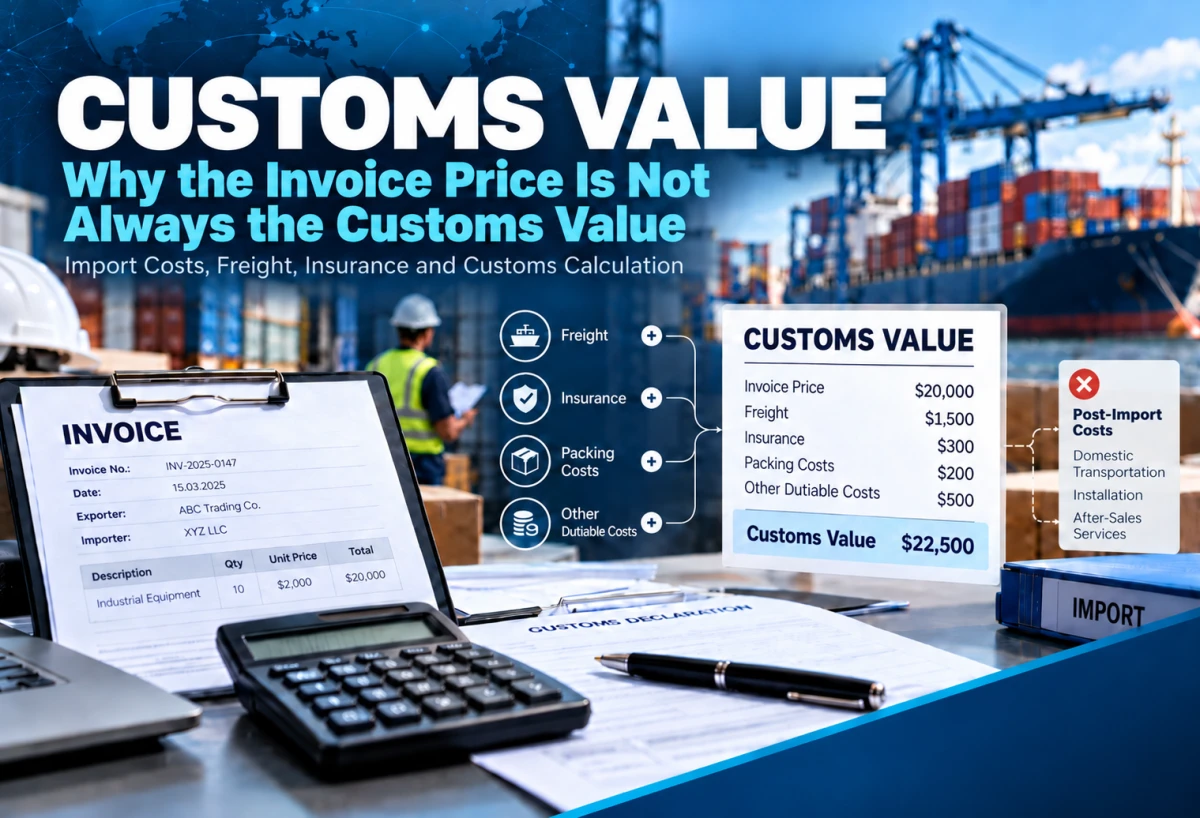
When importing food products, clothing, machinery, or other goods into Armenia, customs duties and taxes are not necessarily calculated using only the amount shown on the commercial invoice. In certain cases, additional expenses must be added to the price, while other expenses may be excluded from the customs value.
Correct customs valuation is one of the most important stages of importing goods. An incorrect calculation may result in additional tax liabilities, document checks, customs value adjustments, or delays in the release of the shipment.
1. What is the customs value of goods?
Customs value is the value determined under customs legislation and used, among other purposes, to calculate applicable import duties and taxes.
Under Article 39 of the EAEU Customs Code, the primary method of customs valuation is based on the transaction value. This is the price actually paid or payable for the imported goods, adjusted as required under Article 40 of the Code.
Therefore, the invoice price and the customs value are not always the same.
Customs value must not be determined using arbitrary or fictitious prices. It must be based on reliable, quantifiable, and properly documented information.
2. Which expenses may be added to the invoice price?
Where the transaction value method applies, certain expenses specified in Article 40 of the EAEU Customs Code must be added to the price to the extent that they have not already been included.
These may include:
- Transportation costs up to the legally designated place of arrival in the EAEU customs territory.
- Applicable loading, unloading, and transshipment costs associated with transportation up to that place.
- Insurance costs related to the relevant transportation and handling operations.
- Certain container and packing costs.
- Certain commissions and brokerage fees, excluding qualifying buying commissions.
- The value of certain materials, tools, design work, and production-related services supplied by the buyer free of charge or at a reduced cost.
- Certain licence fees and royalties when the legal conditions for their inclusion are satisfied.
- A portion of the proceeds from subsequent resale or use that directly or indirectly accrues to the seller.
Important: These costs must not be counted twice. If already included in the price actually paid or payable, they should not be added again.
3. Transportation costs: why does the EAEU customs border matter?
A common mistake in customs valuation is automatically including the entire freight cost without examining the transport route and supporting documentation.
Article 40 of the EAEU Customs Code establishes the principle of including transportation costs up to the relevant place of arrival in the EAEU customs territory. Depending on the mode of transport, special rules adopted by the Eurasian Economic Commission may apply.
For example, if a shipment from China to Armenia first enters the EAEU customs territory through Russia, it is necessary to determine which portion of the international transportation expenses relates to the journey before the relevant place of arrival and which portion relates to onward transportation.
Expenses relating to the onward transportation segment may be excluded from customs value where the legal requirements for separating, declaring, and documenting those expenses are satisfied.
This does not mean that all transportation expenses incurred within the EAEU are automatically excluded from customs value. The applicable rules and supporting documents are decisive.
4. Which expenses are excluded from customs value?
Under Article 40(2) of the EAEU Customs Code, certain costs must not be included in customs value if they are distinguished from the price actually paid or payable, declared by the declarant, and properly documented.
- Applicable construction, assembly, installation, maintenance, or technical assistance costs relating to industrial plants, machinery, or equipment after importation.
- Transportation costs within the EAEU customs territory after the relevant place of arrival.
- Applicable duties, taxes, and fees paid in connection with the importation or sale of goods within the EAEU.
Important: Merely describing an expense as excluded is insufficient. The exclusion must have a valid legal basis and appropriate documentary support.
5. Practical example of customs value calculation
Assume an Armenian company imports industrial equipment with the following costs:
| Cost component | Amount (USD) |
|---|---|
| Commercial invoice price | 20,000 |
| Transportation costs subject to inclusion | 1,500 |
| Insurance subject to inclusion | 300 |
| Separately paid packing costs subject to inclusion | 200 |
| Other legally applicable additions | 500 |
| Total customs value | 22,500 |
In this example, the customs value is USD 22,500, rather than USD 20,000.
This calculation is illustrative. It assumes that all additional expenses are properly documented, have not already been included in the price, and qualify for inclusion under applicable legislation.
The final amounts of customs duties and VAT also depend on the EAEU HS classification, applicable rates, exemptions, and the tax base established by legislation.
The VAT tax base is not always limited to customs value alone.
6. How do EXW, FOB, CIF, and DAP affect customs value?
Incoterms delivery terms play an important role in determining how transportation costs and responsibilities are allocated between the seller and the buyer.
EXW (Ex Works)
The buyer generally arranges and pays for a substantial part of the transportation. It is necessary to determine which expenses must be added to customs value.
FOB (Free on Board)
The price generally includes delivery to the port of shipment and loading the goods on board the vessel under the relevant terms. Subsequent transportation and insurance costs must be assessed separately.
CIF (Cost, Insurance and Freight)
The price generally includes the cost of goods, transportation to the agreed destination port, and insurance. These expenses must not be added again if already included.
DAP (Delivered at Place)
The seller generally arranges transportation to the named place of destination. If the price includes expenses that may legally be excluded from customs value, proper documentary separation is required.
Important: Incoterms do not themselves determine customs value. They help establish the allocation of costs, while customs value is determined under EAEU legislation.
7. How is customs value determined when the transaction value method cannot be applied?
In certain circumstances, the transaction value method cannot be used, for example, when the relevant legal requirements are not satisfied or reliable and quantifiable information is unavailable.
The EAEU Customs Code provides six customs valuation methods:
- Transaction value of the imported goods.
- Transaction value of identical goods.
- Transaction value of similar goods.
- Deductive value method.
- Computed value method.
- Fallback method.
The methods must be applied in the sequence established by the Code, taking into account the permitted reversal of the fourth and fifth methods.
Customs authorities' doubts concerning the declared value do not, by themselves, permit an arbitrary replacement of the price. Verification and valuation must comply with applicable legal requirements.
8. Which documents are important for supporting customs value?
Depending on the transaction, relevant documents may include:
- The international sales contract and amendments.
- The Commercial Invoice.
- The Packing List.
- The freight agreement, CMR, Air Waybill, or Bill of Lading.
- Freight invoices and payment confirmations.
- Insurance agreements or certificates.
- Payment confirmations for the goods.
- Licence agreements and other relevant contracts affecting customs value.
- Other documents supporting the declared customs value.
The required documentation depends on the nature of the individual transaction rather than one universal mandatory list for all imports.
9. Three common mistakes made by importers
Mistake 1. Treating the invoice price as the final customs value
Without examining freight, insurance, and other expenses, the invoice price may provide an incorrect basis for calculating import payments.
Mistake 2. Including the entire freight cost in customs value
In some cases, part of the transportation expenses may legally be excluded when supported by appropriate documentation.
Mistake 3. Failing to clarify costs before shipping
Reviewing delivery terms and cost components in advance allows importers to estimate their actual expenses more accurately.
10. What does REGULUS GROUP recommend?
Before purchasing and shipping goods, we recommend:
- Reviewing the sales contract and delivery terms.
- Confirming the actual price paid or payable.
- Separately identifying transportation, insurance, and other expenses.
- Checking which expenses must be included in customs value.
- Calculating customs value and estimated import payments in advance.
REGULUS GROUP assists importers with preliminary document analysis, customs value assessments, professional customs consulting, and customs declaration procedures.
Correctly determined customs value means a well-supported calculation, reduced risks, and more predictable import costs.
Legal basis and official sources
Eurasian Economic Union Customs Code, Chapter 5, Articles 38–45, particularly:
- Article 38 — General provisions on customs value.
- Article 39 — Transaction value method for imported goods.
- Article 40 — Additional amounts and excluded expenses.
- Articles 41–45 — Other customs valuation methods.
EAEU Customs Code — official text
REGULUS GROUP services
Review your import documents and customs value calculation before shipping goods to Armenia.